What Two Characteristics Can Be Used to Classify Electromagnetic Rays?
| Course | Wave- length | Freq- uency | Energy per photon | |||
|---|---|---|---|---|---|---|
| Ionizing radiation | γ | Gamma rays | one pm | 300 EHz | 1.24 MeV | |
| x pm | 30 EHz | 124 keV | ||||
| HX | Hard X-rays | |||||
| 100 pm | 3 EHz | 12.4 keV | ||||
| SX | Soft X-rays | |||||
| i nm | 300 PHz | i.24 keV | ||||
| 10 nm | thirty PHz | 124 eV | ||||
| EUV | Extreme ultraviolet | |||||
| 100 nm | 3 PHz | 12.4 eV | ||||
| NUV | Near ultraviolet, visible | |||||
| 1 μm | 300 THz | 1.24 eV | ||||
| NIR | Near infrared | |||||
| 10 μm | 30 THz | 124 meV | ||||
| MIR | Mid infrared | |||||
| 100 μm | 3 THz | 12.4 meV | ||||
| FIR | Far infrared | |||||
| 1 mm | 300 GHz | one.24 meV | ||||
| Micro- waves and radio | EHF | Extremely high frequency | ||||
| 1 cm | xxx GHz | 124 μeV | ||||
| SHF | Super loftier frequency | |||||
| 1 dm | 3 GHz | 12.four μeV | ||||
| UHF | Ultra high frequency | |||||
| i m | 300 MHz | one.24 μeV | ||||
| VHF | Very high frequency | |||||
| 10 1000 | thirty MHz | 124 neV | ||||
| HF | High frequency | |||||
| 100 yard | 3 MHz | 12.4 neV | ||||
| MF | Medium frequency | |||||
| 1 km | 300 kHz | i.24 neV | ||||
| LF | Depression frequency | |||||
| 10 km | 30 kHz | 124 peV | ||||
| VLF | Very low frequency | |||||
| 100 km | iii kHz | 12.four peV | ||||
| ULF | Ultra low frequency | |||||
| 1 Mm | 300 Hz | ane.24 peV | ||||
| SLF | Super low frequency | |||||
| x Mm | 30 Hz | 124 feV | ||||
| ELF | Extremely depression frequency | |||||
| 100 Mm | three Hz | 12.iv feV | ||||
| Sources: File:Light spectrum.svg[i] [2] [3] | ||||||


The electromagnetic spectrum is the range of frequencies (the spectrum) of electromagnetic radiations and their respective wavelengths and photon energies.
The electromagnetic spectrum covers electromagnetic waves with frequencies ranging from below 1 hertz to higher up 1025 hertz, corresponding to wavelengths from thousands of kilometers downward to a fraction of the size of an diminutive nucleus. This frequency range is divided into split bands, and the electromagnetic waves within each frequency band are called past unlike names; beginning at the low frequency (long wavelength) end of the spectrum these are: radio waves, microwaves, infrared, visible calorie-free, ultraviolet, X-rays, and gamma rays at the high-frequency (short wavelength) end. The electromagnetic waves in each of these bands accept different characteristics, such every bit how they are produced, how they interact with matter, and their practical applications. There is no known limit for long wavelengths, while it is thought that the short wavelength limit is in the vicinity of the Planck length.[4] Extreme ultraviolet, soft X-rays, hard Ten-rays and gamma rays are classified every bit ionizing radiation as their photons accept enough free energy to ionize atoms, causing chemical reactions. Exposure to these rays can be a health hazard, causing radiation sickness, DNA harm and cancer. Radiation of visible lite wavelengths and lower are called nonionizing radiation as they cannot cause these effects.
In nearly of the frequency bands to a higher place, a technique called spectroscopy can be used to physically separate waves of different frequencies, producing a spectrum showing the constituent frequencies. Spectroscopy is used to study the interactions of electromagnetic waves with matter.[5] Other technological uses are described under electromagnetic radiations.
History and discovery [edit]
Humans have always been aware of visible light and radiant estrus simply for most of history it was not known that these phenomena were continued or were representatives of a more extensive principle. The aboriginal Greeks recognized that light traveled in straight lines and studied some of its properties, including reflection and refraction. Light was intensively studied from the beginning of the 17th century leading to the invention of important instruments like the telescope and microscope. Isaac Newton was the beginning to apply the term spectrum for the range of colours that white light could be separate into with a prism. Starting in 1666, Newton showed that these colours were intrinsic to low-cal and could exist recombined into white light. A argue arose over whether light had a wave nature or a particle nature with René Descartes, Robert Hooke and Christiaan Huygens favouring a wave description and Newton favouring a particle description. Huygens in particular had a well developed theory from which he was able to derive the laws of reflection and refraction. Around 1801, Thomas Young measured the wavelength of a light axle with his 2-slit experiment thus conclusively demonstrating that light was a moving ridge.
In 1800, William Herschel discovered infrared radiation.[six] He was studying the temperature of different colours by moving a thermometer through light split past a prism. He noticed that the highest temperature was across reddish. He theorized that this temperature change was due to "calorific rays", a type of light ray that could non be seen. The next yr, Johann Ritter, working at the other terminate of the spectrum, noticed what he called "chemic rays" (invisible low-cal rays that induced sure chemical reactions). These behaved similarly to visible violet light rays, but were across them in the spectrum.[7] They were later renamed ultraviolet radiation.
The study of electromagnetism began in 1820 when Hans Christian Ørsted discovered that electric currents produce magnetic fields (Oersted's law). Low-cal was first linked to electromagnetism in 1845, when Michael Faraday noticed that the polarization of low-cal traveling through a transparent material responded to a magnetic field (come across Faraday effect). During the 1860s, James Clerk Maxwell adult four partial differential equations (Maxwell'south equations) for the electromagnetic field. Ii of these equations predicted the possibility and behavior of waves in the field. Analyzing the speed of these theoretical waves, Maxwell realized that they must travel at a speed that was about the known speed of light. This startling coincidence in value led Maxwell to make the inference that calorie-free itself is a blazon of electromagnetic moving ridge. Maxwell's equations predicted an infinite range of frequencies of electromagnetic waves, all traveling at the speed of low-cal. This was the commencement indication of the existence of the unabridged electromagnetic spectrum.
Maxwell's predicted waves included waves at very depression frequencies compared to infrared, which in theory might be created by oscillating charges in an ordinary electrical circuit of a certain type. Attempting to prove Maxwell's equations and detect such low frequency electromagnetic radiation, in 1886, the physicist Heinrich Hertz built an apparatus to generate and detect what are at present called radio waves. Hertz found the waves and was able to infer (by measuring their wavelength and multiplying it by their frequency) that they traveled at the speed of lite. Hertz also demonstrated that the new radiation could be both reflected and refracted past various dielectric media, in the same style as light. For instance, Hertz was able to focus the waves using a lens made of tree resin. In a later experiment, Hertz similarly produced and measured the properties of microwaves. These new types of waves paved the way for inventions such as the wireless telegraph and the radio.
In 1895, Wilhelm Röntgen noticed a new type of radiation emitted during an experiment with an evacuated tube subjected to a high voltage. He called this radiation "x-rays" and found that they were able to travel through parts of the human being trunk but were reflected or stopped past denser matter such as bones. Earlier long, many uses were found for this radiography.
The last portion of the electromagnetic spectrum was filled in with the discovery of gamma rays. In 1900, Paul Villard was studying the radioactive emissions of radium when he identified a new type of radiations that he at offset idea consisted of particles similar to known alpha and beta particles, but with the power of being far more penetrating than either. Notwithstanding, in 1910, British physicist William Henry Bragg demonstrated that gamma rays are electromagnetic radiations, non particles, and in 1914, Ernest Rutherford (who had named them gamma rays in 1903 when he realized that they were fundamentally different from charged alpha and beta particles) and Edward Andrade measured their wavelengths, and found that gamma rays were similar to X-rays, merely with shorter wavelengths.
The wave-particle debate was rekindled in 1901 when Max Planck discovered that lite is only absorbed in discrete "quanta", now chosen photons, implying that low-cal has a particle nature. This thought was made explicit past Albert Einstein in 1905, but never accepted past Planck and many other contemporaries. The modern position of scientific discipline is that electromagnetic radiation has both a wave and a particle nature, the moving ridge-particle duality. The contradictions arising from this position are still being debated by scientists and philosophers.
Range [edit]
Electromagnetic waves are typically described past any of the following 3 physical properties: the frequency f, wavelength λ, or photon energy E. Frequencies observed in astronomy range from two.4×1023 Hz (i GeV gamma rays) down to the local plasma frequency of the ionized interstellar medium (~ane kHz). Wavelength is inversely proportional to the wave frequency,[5] so gamma rays have very curt wavelengths that are fractions of the size of atoms, whereas wavelengths on the opposite end of the spectrum can be indefinitely long. Photon energy is directly proportional to the wave frequency, so gamma ray photons have the highest energy (effectually a billion electron volts), while radio wave photons accept very low energy (effectually a femtoelectronvolt). These relations are illustrated by the post-obit equations:

where:
- c = 299792 458 grand/s is the speed of calorie-free in a vacuum
- h = 6.626070 xv ×x−34 J·s = 4.135667 33(10)×10−15 eV·s is Planck's constant.[8]
Whenever electromagnetic waves exist in a medium with matter, their wavelength is decreased. Wavelengths of electromagnetic radiations, whatever medium they are traveling through, are normally quoted in terms of the vacuum wavelength, although this is non always explicitly stated.
Generally, electromagnetic radiation is classified by wavelength into radio wave, microwave, infrared, visible calorie-free, ultraviolet, Ten-rays and gamma rays. The behavior of EM radiation depends on its wavelength. When EM radiation interacts with single atoms and molecules, its beliefs also depends on the corporeality of free energy per quantum (photon) information technology carries.
Spectroscopy can detect a much wider region of the EM spectrum than the visible wavelength range of 400 nm to 700 nm in a vacuum. A common laboratory spectroscope can detect wavelengths from 2 nm to 2500 nm.[ citation needed ] Detailed data about the physical backdrop of objects, gases, or even stars can be obtained from this type of device. Spectroscopes are widely used in astrophysics. For example, many hydrogen atoms emit a radio wave photon that has a wavelength of 21.12 cm. Also, frequencies of 30 Hz and below can be produced past and are of import in the study of sure stellar nebulae[9] and frequencies equally loftier as ii.9×1027 Hz take been detected from astrophysical sources.[10]
Regions [edit]

The electromagnetic spectrum
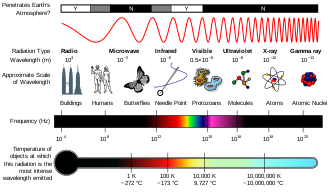
A diagram of the electromagnetic spectrum, showing various properties across the range of frequencies and wavelengths
The types of electromagnetic radiation are broadly classified into the following classes (regions, bands or types):[5]
- Gamma radiations
- Ten-ray radiation
- Ultraviolet radiation
- Visible light
- Infrared radiations
- Microwave radiation
- Radio waves
This nomenclature goes in the increasing social club of wavelength, which is characteristic of the type of radiation.[5]
There are no precisely defined boundaries between the bands of the electromagnetic spectrum; rather they fade into each other like the bands in a rainbow (which is the sub-spectrum of visible light). Radiation of each frequency and wavelength (or in each band) has a mix of properties of the two regions of the spectrum that bound it. For example, red lite resembles infrared radiation in that information technology can excite and add together energy to some chemic bonds and indeed must practice so to power the chemical mechanisms responsible for photosynthesis and the working of the visual system.
The distinction between X-rays and gamma rays is partly based on sources: the photons generated from nuclear decay or other nuclear and subnuclear/particle process are always termed gamma rays, whereas 10-rays are generated past electronic transitions involving highly energetic inner diminutive electrons.[eleven] [12] [thirteen] In full general, nuclear transitions are much more energetic than electronic transitions, so gamma rays are more than energetic than X-rays, but exceptions exist. By analogy to electronic transitions, muonic atom transitions are also said to produce X-rays, even though their energy may exceed 6 megaelectronvolts (0.96 pJ),[14] whereas there are many (77 known to be less than x keV (1.6 fJ)) depression-free energy nuclear transitions (east.g., the 7.half-dozen eV (1.22 aJ) nuclear transition of thorium-229m), and, despite being ane million-fold less energetic than some muonic X-rays, the emitted photons are still called gamma rays due to their nuclear origin.[xv]
The convention that EM radiation that is known to come from the nucleus is always called "gamma ray" radiation is the only convention that is universally respected, however. Many astronomical gamma ray sources (such every bit gamma ray bursts) are known to be too energetic (in both intensity and wavelength) to be of nuclear origin. Quite oftentimes, in high-energy physics and in medical radiotherapy, very loftier energy EMR (in the > 10 MeV region)—which is of higher free energy than whatsoever nuclear gamma ray—is not called 10-ray or gamma ray, but instead by the generic term of "loftier-energy photons".
The region of the spectrum where a item observed electromagnetic radiation falls is reference frame-dependent (due to the Doppler shift for calorie-free), so EM radiation that i observer would say is in one region of the spectrum could appear to an observer moving at a substantial fraction of the speed of low-cal with respect to the first to exist in some other part of the spectrum. For example, consider the cosmic microwave background. It was produced when affair and radiation decoupled, by the de-excitation of hydrogen atoms to the ground state. These photons were from Lyman series transitions, putting them in the ultraviolet (UV) part of the electromagnetic spectrum. Now this radiation has undergone enough cosmological red shift to put it into the microwave region of the spectrum for observers moving slowly (compared to the speed of calorie-free) with respect to the cosmos.
Rationale for names [edit]
Electromagnetic radiations interacts with matter in different ways across the spectrum. These types of interaction are and so unlike that historically different names accept been applied to unlike parts of the spectrum, as though these were dissimilar types of radiation. Thus, although these "different kinds" of electromagnetic radiation course a quantitatively continuous spectrum of frequencies and wavelengths, the spectrum remains divided for applied reasons related to these qualitative interaction differences.
| Region of the spectrum | Main interactions with matter |
|---|---|
| Radio | Collective oscillation of charge carriers in majority material (plasma oscillation). An example would be the oscillatory travels of the electrons in an antenna. |
| Microwave through far infrared | Plasma oscillation, molecular rotation |
| Near infrared | Molecular vibration, plasma oscillation (in metals simply) |
| Visible | Molecular electron excitation (including pigment molecules plant in the homo retina), plasma oscillations (in metals only) |
| Ultraviolet | Excitation of molecular and diminutive valence electrons, including ejection of the electrons (photoelectric effect) |
| Ten-rays | Excitation and ejection of cadre diminutive electrons, Compton scattering (for depression atomic numbers) |
| Gamma rays | Energetic ejection of core electrons in heavy elements, Compton scattering (for all diminutive numbers), excitation of atomic nuclei, including dissociation of nuclei |
| High-energy gamma rays | Creation of particle-antiparticle pairs. At very high energies a single photon can create a shower of high-energy particles and antiparticles upon interaction with matter. |
Types of radiation [edit]
Radio waves [edit]
Radio waves are emitted and received by antennas, which consist of conductors such as metal rod resonators. In artificial generation of radio waves, an electronic device called a transmitter generates an Ac electric electric current which is practical to an antenna. The oscillating electrons in the antenna generate oscillating electric and magnetic fields that radiate away from the antenna as radio waves. In reception of radio waves, the aquiver electric and magnetic fields of a radio wave couple to the electrons in an antenna, pushing them dorsum and forth, creating oscillating currents which are practical to a radio receiver. Earth's atmosphere is mainly transparent to radio waves, except for layers of charged particles in the ionosphere which can reflect certain frequencies.
Radio waves are extremely widely used to transmit information beyond distances in radio communication systems such every bit radio dissemination, idiot box, two manner radios, mobile phones, advice satellites, and wireless networking. In a radio communication system, a radio frequency current is modulated with an information-begetting point in a transmitter past varying either the amplitude, frequency or phase, and practical to an antenna. The radio waves deport the information beyond space to a receiver, where they are received by an antenna and the information extracted by demodulation in the receiver. Radio waves are also used for navigation in systems like Global Positioning Organisation (GPS) and navigational beacons, and locating distant objects in radiolocation and radar. They are too used for remote control, and for industrial heating.
The utilize of the radio spectrum is strictly regulated by governments, coordinated by the International Telecommunications Union (ITU) which allocates frequencies to dissimilar users for different uses.
Microwaves [edit]
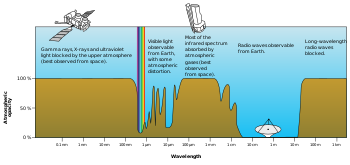
Plot of Earth'due south atmospheric opacity to various wavelengths of electromagnetic radiation. This is the surface-to-space opacity, the atmosphere is transparent to longwave radio transmissions within the troposphere merely opaque to infinite due to the ionosphere.
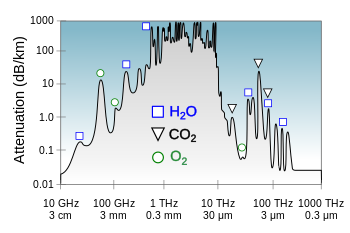
Plot of atmospheric opacity for terrestrial to terrestrial transmission showing the molecules responsible for some of the resonances
Microwaves are radio waves of short wavelength, from almost 10 centimeters to 1 millimeter, in the SHF and EHF frequency bands. Microwave free energy is produced with klystron and magnetron tubes, and with solid land devices such as Gunn and IMPATT diodes. Although they are emitted and captivated by brusque antennas, they are likewise captivated by polar molecules, coupling to vibrational and rotational modes, resulting in bulk heating. Unlike college frequency waves such every bit infrared and light which are absorbed mainly at surfaces, microwaves can penetrate into materials and eolith their energy beneath the surface. This upshot is used to heat nutrient in microwave ovens, and for industrial heating and medical diathermy. Microwaves are the master wavelengths used in radar, and are used for satellite communication, and wireless networking technologies such as Wi-Fi. The copper cables (transmission lines) which are used to carry lower frequency radio waves to antennas have excessive ability losses at microwave frequencies, and metal pipes called waveguides are used to carry them. Although at the depression finish of the band the atmosphere is mainly transparent, at the upper end of the band absorption of microwaves by atmospheric gasses limits practical propagation distances to a few kilometers.
Terahertz radiation or sub-millimeter radiations is a region of the spectrum from about 100 GHz to xxx terahertz (THz) between microwaves and far infrared which can be regarded as belonging to either ring. Until recently, the range was rarely studied and few sources existed for microwave energy in the so-called terahertz gap, but applications such as imaging and communications are now actualization. Scientists are also looking to apply terahertz technology in the armed forces, where high-frequency waves might be directed at enemy troops to incapacitate their electronic equipment.[16] Terahertz radiation is strongly absorbed by atmospheric gases, making this frequency range useless for long-distance communication.
Infrared radiation [edit]
The infrared part of the electromagnetic spectrum covers the range from roughly 300 GHz to 400 THz (ane mm – 750 nm). It can be divided into iii parts:[5]
- Far-infrared, from 300 GHz to 30 THz (ane mm – 10 μm). The lower function of this range may also be chosen microwaves or terahertz waves. This radiation is typically absorbed by so-called rotational modes in gas-stage molecules, by molecular motions in liquids, and past phonons in solids. The water in Earth'due south temper absorbs then strongly in this range that it renders the atmosphere in effect opaque. However, there are certain wavelength ranges ("windows") within the opaque range that permit partial transmission, and can be used for astronomy. The wavelength range from approximately 200 μm up to a few mm is often referred to equally Submillimetre astronomy, reserving far infrared for wavelengths beneath 200 μm.
- Mid-infrared, from 30 to 120 THz (10–2.5 μm). Hot objects (blackness-torso radiators) can radiate strongly in this range, and human being skin at normal body temperature radiates strongly at the lower terminate of this region. This radiations is absorbed past molecular vibrations, where the different atoms in a molecule vibrate around their equilibrium positions. This range is sometimes chosen the fingerprint region, since the mid-infrared absorption spectrum of a compound is very specific for that compound.
- Near-infrared, from 120 to 400 THz (2,500–750 nm). Physical processes that are relevant for this range are similar to those for visible light. The highest frequencies in this region tin be detected direct by some types of photographic movie, and by many types of solid land epitome sensors for infrared photography and videography.
Visible light [edit]
| | |||
|---|---|---|---|
| Colour | Wavelength (nm) | Frequency (THz) | Photon energy (eV) |
| violet | 380–450 | 670–790 | two.75–3.26 |
| blue | 450–485 | 620–670 | two.56–2.75 |
| cyan | 485–500 | 600–620 | 2.48–ii.56 |
| green | 500–565 | 530–600 | ii.xix–two.48 |
| yellow | 565–590 | 510–530 | 2.10–2.nineteen |
| orange | 590–625 | 480–510 | 1.98–ii.10 |
| red | 625–750 | 400–480 | 1.65–1.98 |

Above infrared in frequency comes visible light. The Sun emits its acme ability in the visible region, although integrating the entire emission power spectrum through all wavelengths shows that the Dominicus emits slightly more infrared than visible light.[17] By definition, visible light is the part of the EM spectrum the human middle is the most sensitive to. Visible light (and near-infrared low-cal) is typically captivated and emitted past electrons in molecules and atoms that motility from one free energy level to some other. This activity allows the chemical mechanisms that underlie homo vision and plant photosynthesis. The lite that excites the human visual arrangement is a very minor portion of the electromagnetic spectrum. A rainbow shows the optical (visible) part of the electromagnetic spectrum; infrared (if it could be seen) would exist located simply across the cherry side of the rainbow whilst ultraviolet would appear simply across the opposite violet finish.
Electromagnetic radiations with a wavelength between 380 nm and 760 nm (400–790 terahertz) is detected by the human center and perceived every bit visible light. Other wavelengths, especially near infrared (longer than 760 nm) and ultraviolet (shorter than 380 nm) are besides sometimes referred to as calorie-free, especially when the visibility to humans is not relevant. White calorie-free is a combination of lights of different wavelengths in the visible spectrum. Passing white light through a prism splits it up into the several colours of low-cal observed in the visible spectrum between 400 nm and 780 nm.
If radiations having a frequency in the visible region of the EM spectrum reflects off an object, say, a bowl of fruit, then strikes the eyes, this results in visual perception of the scene. The brain'south visual arrangement processes the multitude of reflected frequencies into dissimilar shades and hues, and through this insufficiently-understood psychophysical phenomenon, most people perceive a bowl of fruit.
At about wavelengths, however, the information carried by electromagnetic radiation is not directly detected by human senses. Natural sources produce EM radiations beyond the spectrum, and technology tin can also manipulate a wide range of wavelengths. Optical fiber transmits calorie-free that, although non necessarily in the visible office of the spectrum (it is usually infrared), can acquit information. The modulation is similar to that used with radio waves.
Ultraviolet radiation [edit]

The amount of penetration of UV relative to altitude in World's ozone
Next in frequency comes ultraviolet (UV). The wavelength of UV rays is shorter than the violet end of the visible spectrum but longer than the 10-ray.
UV is the longest wavelength radiation whose photons are energetic enough to ionize atoms, separating electrons from them, and thus causing chemical reactions. Short wavelength UV and the shorter wavelength radiation to a higher place information technology (X-rays and gamma rays) are called ionizing radiation, and exposure to them tin can damage living tissue, making them a wellness hazard. UV can also cause many substances to glow with visible light; this is chosen fluorescence.
At the middle range of UV, UV rays cannot ionize but tin pause chemical bonds, making molecules unusually reactive. Sunburn, for instance, is caused by the disruptive effects of middle range UV radiations on pare cells, which is the primary cause of peel cancer. UV rays in the middle range can irreparably impairment the complex Dna molecules in the cells producing thymine dimers making it a very potent mutagen.
The Sunday emits pregnant UV radiation (about 10% of its total ability), including extremely short wavelength UV that could potentially destroy most life on land (bounding main h2o would provide some protection for life at that place). However, most of the Sun's dissentious UV wavelengths are absorbed by the atmosphere before they reach the surface. The higher energy (shortest wavelength) ranges of UV (called "vacuum UV") are absorbed by nitrogen and, at longer wavelengths, by simple diatomic oxygen in the air. Nearly of the UV in the mid-range of energy is blocked by the ozone layer, which absorbs strongly in the of import 200–315 nm range, the lower energy part of which is also long for ordinary dioxygen in air to absorb. This leaves less than three% of sunlight at bounding main level in UV, with all of this remainder at the lower energies. The balance is UV-A, along with some UV-B. The very everyman energy range of UV between 315 nm and visible calorie-free (chosen UV-A) is non blocked well by the atmosphere, but does not cause sunburn and does less biological damage. However, it is non harmless and does create oxygen radicals, mutations and pare damage.
10-rays [edit]
Subsequently UV come up X-rays, which, like the upper ranges of UV are besides ionizing. Even so, due to their higher energies, X-rays can also interact with matter by ways of the Compton effect. Hard X-rays have shorter wavelengths than soft 10-rays and as they tin pass through many substances with little absorption, they can be used to 'see through' objects with 'thicknesses' less than that equivalent to a few meters of water. One notable utilize is diagnostic X-ray imaging in medicine (a process known as radiography). X-rays are useful equally probes in loftier-energy physics. In astronomy, the accretion disks around neutron stars and blackness holes emit X-rays, enabling studies of these phenomena. X-rays are also emitted by stellar corona and are strongly emitted by some types of nebulae. All the same, X-ray telescopes must be placed exterior the Earth's temper to see astronomical 10-rays, since the bang-up depth of the atmosphere of Earth is opaque to Ten-rays (with areal density of 1000 g/cm2), equivalent to 10 meters thickness of h2o.[18] This is an amount sufficient to block near all astronomical 10-rays (and too astronomical gamma rays—see beneath).
Gamma rays [edit]
Subsequently hard X-rays come gamma rays, which were discovered past Paul Ulrich Villard in 1900. These are the most energetic photons, having no defined lower limit to their wavelength. In astronomy they are valuable for studying loftier-energy objects or regions, notwithstanding equally with X-rays this can just be done with telescopes outside the World's atmosphere. Gamma rays are used experimentally by physicists for their penetrating ability and are produced by a number of radioisotopes. They are used for irradiation of foods and seeds for sterilization, and in medicine they are occasionally used in radiation cancer therapy.[19] More than unremarkably, gamma rays are used for diagnostic imaging in nuclear medicine, an example being PET scans. The wavelength of gamma rays can be measured with high accuracy through the effects of Compton handful.
See besides [edit]
- Bandplan
- Cosmic ray
- Digital dividend after digital television transition
- Electroencephalography
- Infrared window
- Ionizing radiation
- List of international common standards
- Optical window
- Ozone layer
- Radiant energy
- Radiation
- Radio window
- Spectroscopy
- V ring
- W ring
Notes and references [edit]
- ^ What is Light? Archived December 5, 2013, at the Wayback Car – UC Davis lecture slides
- ^ Elert, Glenn. "The Electromagnetic Spectrum". The Physics Hypertextbook . Retrieved 2022-01-21 .
- ^ Stimac, Tomislav. "Definition of frequency bands (VLF, ELF... etc.)". vlf.it. Retrieved 2022-01-21 .
- ^ Bakshi, U. A.; Godse, A. P. (2009). Basic Electronics Applied science. Technical Publications. pp. viii–10. ISBN978-81-8431-580-vi.
- ^ a b c d east Mehta, Akul (25 August 2011). "Introduction to the Electromagnetic Spectrum and Spectroscopy". Pharmaxchange.info. Retrieved 2011-11-08 .
- ^ "Herschel Discovers Infrared Light". Absurd Cosmos Classroom activities. Archived from the original on 2012-02-25. Retrieved four March 2013.
He directed sunlight through a glass prism to create a spectrum […] then measured the temperature of each colour. […] He found that the temperatures of the colours increased from the violet to the red part of the spectrum. […] Herschel decided to measure the temperature just beyond the blood-red of the spectrum in a region where no sunlight was visible. To his surprise, he institute that this region had the highest temperature of all.
- ^ Davidson, Michael Westward. "Johann Wilhelm Ritter (1776–1810)". The Florida State University. Retrieved five March 2013.
Ritter […] hypothesized that at that place must also exist invisible radiation beyond the violet end of the spectrum and commenced experiments to ostend his speculation. He began working with silver chloride, a substance decomposed by lite, measuring the speed at which unlike colours of lite broke it downward. […] Ritter […] demonstrated that the fastest rate of decomposition occurred with radiation that could not exist seen, just that existed in a region beyond the violet. Ritter initially referred to the new blazon of radiation as chemical rays, but the championship of ultraviolet radiation somewhen became the preferred term.
- ^ Mohr, Peter J.; Taylor, Barry North.; Newell, David B. (2008). "CODATA Recommended Values of the Fundamental Physical Constants: 2006" (PDF). Reviews of Modern Physics. 80 (ii): 633–730. arXiv:0801.0028. Bibcode:2008RvMP...80..633M. doi:x.1103/RevModPhys.80.633. Archived from the original (PDF) on 2017-10-01. Direct link to value.
- ^ Condon, J. J.; Ransom, S. Thousand. "Essential Radio Astronomy: Pulsar Properties". National Radio Astronomy Observatory. Archived from the original on 2011-05-04. Retrieved 2008-01-05 .
- ^ Abdo, A. A.; Allen, B.; Berley, D.; Blaufuss, E.; Casanova, S.; Chen, C.; Coyne, D. G.; Delay, R. S.; Dingus, B. L.; Ellsworth, R. W.; Fleysher, L.; Fleysher, R.; Gebauer, I.; Gonzalez, G. M.; Goodman, J. A.; Hays, E.; Hoffman, C. Yard.; Kolterman, B. Eastward.; Kelley, L. A.; Lansdell, C. P.; Linnemann, J. T.; McEnery, J. E.; Mincer, A. I.; Moskalenko, I. V.; Nemethy, P.; Noyes, D.; Ryan, J. M.; Samuelson, F. W.; Saz Parkinson, P. M.; et al. (2007). "Discovery of TeV Gamma-Ray Emission from the Cygnus Region of the Galaxy". The Astrophysical Journal. 658 (i): L33–L36. arXiv:astro-ph/0611691. Bibcode:2007ApJ...658L..33A. doi:10.1086/513696. S2CID 17886934.
- ^ Feynman, Richard; Leighton, Robert; Sands, Matthew (1963). The Feynman Lectures on Physics, Vol.1 . USA: Addison-Wesley. pp. 2–5. ISBN978-0-201-02116-5.
- ^ L'Annunziata, Michael; Baradei, Mohammad (2003). Handbook of Radioactivity Analysis. Bookish Printing. p. 58. ISBN978-0-12-436603-ix.
- ^ Grupen, Claus; Cowan, G.; Eidelman, S. D.; Stroh, T. (2005). Astroparticle Physics . Springer. p. 109. ISBN978-3-540-25312-9.
- ^ Corrections to muonic X-rays and a possible proton halo slac-pub-0335 (1967)
- ^ "Gamma-Rays". Hyperphysics.phy-astr.gsu.edu. Retrieved 2010-10-16 .
- ^ "Advanced weapon systems using lethal Short-pulse terahertz radiations from high-intensity-laser-produced plasmas". India Daily. March 6, 2005. Archived from the original on six January 2010. Retrieved 2010-09-27 .
- ^ "Reference Solar Spectral Irradiance: Air Mass 1.v". Retrieved 2009-xi-12 .
- ^ Koontz, Steve (26 June 2012) Designing Spacecraft and Mission Operations Plans to Run across Flight Crew Radiation Dose. NASA/MIT Workshop. Run across pages I-vii (temper) and I-23 (for h2o).
- ^ Uses of Electromagnetic Waves | gcse-revision, physics, waves, uses-electromagnetic-waves | Revision Globe
External links [edit]
- Australian Radiofrequency Spectrum Allocations Chart (from Australian Communications and Media Authority)
- Canadian Tabular array of Frequency Allocations Archived 2008-12-09 at the Wayback Car (from Industry Canada)
- U.S. Frequency Allocation Chart – Covering the range iii kHz to 300 GHz (from Department of Commerce)
- UK frequency allocation table (from Ofcom, which inherited the Radiocommunications Agency's duties, pdf format)
- Flash EM Spectrum Presentation / Tool – Very complete and customizable.
- Affiche "Electromagnetic Radiations Spectrum" (992 kB)
mcduffieanall1979.blogspot.com
Source: https://en.wikipedia.org/wiki/Electromagnetic_spectrum
0 Response to "What Two Characteristics Can Be Used to Classify Electromagnetic Rays?"
Postar um comentário